Monday, 14 October 2013

Peal in two places

Unlike most wacky ideas, I was not in the pub when this one presented itself. A work conference in April included a presentation entitled ‘LOLA - LOw LAtency Audio Visual Streaming System’ and began with a live performance of Beethoven’s Sonata in A Major Op. 69. However, only the cello player was in the room, the pianist was 250 miles away in Edinburgh (see p34 -35, which includes the computer setup needed). Within a few seconds I knew a use for this.

The LOLA project had started in 2005 and the first UK performance was in September 2012, so was very new. Retiring for the evening, I contacted ringers at home to find others suitably excited, so I sought out one of the presenters the next day.

Gill Davies is a researcher in distributed music over high speed research networks at Edinburgh Napier University. After a discussion, Gill could find time in July to help us. There were only three systems capable of running LOLA in the UK and as one was at Edinburgh Napier, so the plan was to find a couple of Scottish ringers to participate. Initial enquiries for a vague 'handbell peal with a difference' met with a positive response, but we could not find a suitable date. Then my wife reminded me I'd be in Scotland for the Cumberland Country Meeting and that I should ring. I enquired with janet (the provider of the educational computer network in the UK)  to see if one of the other two system could be booked to come to Derby the week before we rang. Emma Smith confirmed the kit was available and so the date was set.

Far more non-ringers knew about the peal than ringers. My concern was that, once other ringers knew it was possible, the race would be on to ring the first peal!

Not being a very accomplished handbell ringer, I thought that if I could use LOLA, then most other people could. Two enthusiastic people in Derby were found, but I still needed one more for Edinburgh. Ideally a conductor in both locations would be best and then I realised that Emma Southerington would be at the meeting - sorted!

Next we had to decide which pairs to ring, where they should be and which set of bells to ring. We thought it best to have a 1-4 and 5-8 split. Now, which bells? We had access to the Derby D A set that once belonged to Sir A P Heywood (size 15). These have round clappers and are quite loud. I also have a new ‘pocket’ set of Whitechapel bells, size 10, which are much quieter. I decided to split and take both sets. It’s a long way to go to find the bells were not suitable.

Having used Hawkear for the 12 bell competition over the past few years, we knew that errors of 50 milliseconds are easily detectable by the human ear. We needed to be well below this to make the system work. LOLA promised, with the right setup, delays of as low as 14ms between Derby and Edinburgh. A 5ms delay is introduced by the software, the rest is dictated by the network equipment and distance between the 2 locations. The system has heavy network requirements. Most people have ‘up to 8Mbps’ to their home. A growing number have up to 80Mbps. This system, using colour at 60 frames a second mode needs over 500Mbps. To further speed up the system in Derby, it was plugged directly into the Internet, bypassing firewalls and other systems that protect the innocent user from the ravages of the Internet.

The last consideration was around the room type. Ringing handbells in the bathroom is completely different to the lounge. Fortunately we ended up in music studios in both locations, so the bells sounded fine.

On the 5th of July, the system arrived in Derby. To cut a long story short, I left for Scotland on Wednesday without testing the connection to Edinburgh. The technical details are below.

On the day of the peal, once the Derby contingent had got into the building, we tried both sets of bells and decided the quieter ones were best. The delay was 24ms. The sound was ace! It sounded like 4 ringers in one room ringing 8 handbells ringing Plain Bob, we could hear Simon conducting as if he was in the same room. Initially there was a perceived gap between the locations and the first attempt at plain hunt took some getting used to. Something similar to perceptual adaptation took over during the ringing and our brains recalibrated to take account of delay, see Science Club - playing tricks on the mind. Listening to the youtube video of the end of the peal, ( http://goo.gl/tzdY2S ) the delays didn’t sound so obvious, though, which rather points to them being a subjective effect.


Society of Royal Cumberland Youths
Derby & Edinburgh, England & Scotland
University of Derby & Edinburgh Napier University
Sunday, 14 July 2013 in 2h29 (10)
5024 Plain Bob Major
Composed by Simon Humphrey
1–2 Anthony P Cotton
3–4 Emma J Southerington
5–6 Simon Humphrey (C)
7–8 Christian M Peckham
Ringers of 1-2 & 3-4 were in Edinburgh, 5-6 & 7-8 were in Derby.
With thanks to:
Gill Davies, Paul Ferguson and Niall Sinclair from Edinburgh Napier University
Claudio Allocchio and the lola project team
Emma Smith from Janet
Roger Browne from EMMAN
Mark Randell and Tony Iveson from University of Derby

This gives you an idea of the setup in Derby, 5-6 in the foreground:
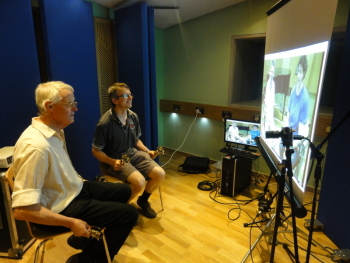
Ringing in Derby, 5-6 in the foreground


Count down to the peal:

T-12 days - Visit the studio, which is a 10 minute bus ride away, to configure and test the Internet connection, which doesn't work. They must have configured it wrong. Luckily they had which was easy to rectify.


T-11 days - Visit studio again and the Internet is working. Using speedtest.net, I’m getting 760Mbps. Happy with that. This later improved to 876Mpbs.


T-9 days - The equipment arrives in 2 large crates and I set it up next to my desk. Testing went well until I started the software, which brought an error. HELP! Although the equipment was tested before shipping, it was not working. Using Skype, I was able to contact the developer in Italy, however the system had no microphone, so we ended up talking on the phone! By home time, one issue had been resolved, but another appeared. The camera did not display an image. Give up and go home...


T-8 days - Pop into work on Saturday, plug everything back together again, still not working. Plug in spare camera, not working. Plug back the original camera and switch on - it works! Time to go home, before anything else breaks!


T-6 days - Transfer the system to the studio on the bus. As I get off the bus, a reversing car bumps into the crate and knocks it off the trolley - fortunately it is well padded. Set up the equipment with Mark Randall, audio technician from the University, who provided microphones and speakers. First proper test to Italy. It’s all working. Simon Humphrey arrives to see the installation. However, all is not well. The video in Italy is stuttering. It’s fine in Derby... Many hours later, come up with two things to try - swap the PC to see if this is the fault and test to Napier to see if this works.


T-5 days - I take my work PC apart, which was almost identical to the LOLA system, and swap the cards over. Switch on and it works. Connect to Italy and it works for a while, but then fails with the same issue as the day before. Unfortunately, testing with Edinburgh is not possible as they are moving buildings and Paul Ferguson is on holiday.


Later in the evening, Claudio in Italy confirms that he has been looking at the data they have been
getting over the network. It transpires that he was getting all the right packets, not necessarily in the right order. I look at the network monitoring and find that there is a large amount of errors (around 1 million!) between our sites in Derby. Network fibre has a pair of cables, one for sending and one for receiving. The errors were on the fibre that sends the traffic to Italy. The graph shows a blue line to Italy, and a flat green line from Italy.


T-4 days - Replacing the fibre is not an option without taking down the University internet connection - I would not be popular! The resilient link between our sites was in the process of being setup, so that was not an option. Around 10am, EMMAN suggested using the University's resilient link. This has a longer path via Mansfield and Lincoln to Nottingham (the primary route goes direct to Nottingham) which will introduce more latency (delay). Let’s try it! By 11.30am it was working and there was no stuttering in Italy! As I would not be in Derby for the peal, I set up the room with the speakers, projector, etc and left for Scotland without doing a test to Napier - fingers crossed!
Unfinished communications cabinet


T-3 days - Finish ringing a peal to find that Paul Ferguson from Napier had returned from holiday and tried to contact me. Left a message with him to see if I could visit tomorrow.


T-2 days - After a peal in the morning, I had the afternoon off, so visited Napier to try a test with Mark Randell in Derby. After an initial problem with the sound (which meant communicating via written messages held up to the camera as there was no mobile phone signal), all was working - we’re on! As the picture shows, the facility was still being put together. Our computer was the only one plugged in!


T-1 day - I though I'd better check with the SRCY officers that they were happy with us ringing it for the Cumberlands.

Network traffic during the peal
D Day arrived. At the Edinburgh end, Paul, Gill and Niall Sinclair (music student) where there to help us. Gill and Niall sat through the whole peal. At the allotted time, there was no sign of anyone from Derby. It transpired that the security team had not got the message to let them in the building! Once they were in, again we had sound issues, which we were able to resolve quickly this time.


Emma, in Edinburgh, takes up the story:

The equipment:
- we had microphones right by our bells - mine was about waist height (when sitting) and a tiny bit to the left.
- there was a speaker where 5-6 would 'sit' and a speaker where 7-8 would 'sit'
- in between the speakers was the largest TV I have ever seen - on a very low hanging stand, so that the visual effect was that we were sitting at the same level and we were about the right size too, but a bit more squashed - the camera adds at least 10lbs width-ways!
- there was a camera fractionally above the TV filming us


The sound:
- there wasn't any detectable delay if you ring by ears: when I closed my eyes to ring, we could have been in the same room
- the sound was ace. it sounded like 4 ringers in one room ringing 8 handbells ringing plain bob! :) we were in a brand new music centre at Edinburgh Napier. It's not open to the Students til October; and so all the equipment, computers and speakers and things were pretty whizzy and shiny.
- Anthony brought two 1,2,3,4s to Edinburgh and the Derby lot had two 5,6,7,8s: we tried both sets of bells, and the lighter set which had dampeners on the clapper pegs produced a clearer sound
- we could hear Simon (c)-ing as if he was in the same room

The visuals:
- there was a tiny tiny fractional delay on the visual side of things: when you look to pick out coursing order, the bells didn't move when you expect them to: the smallest tiniest delay is seen, a bit like ringing with a competent but nervous less experienced ringer who's over-thinking
- we started slowly: 2h52 speed for the first quarter. Everything was easier when we sped up to 2h14 speed: I didn't particularly notice the visual delay when we were ringing quicker.
- there wasn't really a limiting factor for speed: we started slowly as this was a new experience. If four people are sitting in a circle, there is the vertical movement of handbells, but also an amount of horizontal movement - ie the other ringers' bells move out towards the middle of the circle. on a screen, this "outwards" movement isn't there, and so its a bit like ringing with a very tidy ringer. When ringers have quite a flamboyant visual style, its just a bit different to what you would normally expect, and so we started very very steadily.
- the cameras were set so that if Simon and I grinned at each other in the 3456 rollups, we could catch each other's eyes, as if he was sitting next to me.

Other stuff:
- the only "speed worry" I thought we had, was whether the connection would last perfectly in both audio and visual for the duration of the peal: it did! (I was also a bit worried that the 2 research students in Edinburgh might just say "HOW much longer?! I thought this was only going to be a couple of hours..." (they didn't).
- I asked about ringing over distances (ie ringing with people in India or the USA) and the latency increases substantially; I can't remember what the audio detection limit is (40ms?) or the latency drop for distance; but its so many milliseconds per km. In basic-for-Emma-terms: once you get to Europe distance, then things are OK, but above Europe distance, then things aren't (sorry to bring bad news!) and an audio delay is detectable. We had 19ms latency at the start; and so (other than the musical notes) the sound from Anthony's pair were indistinguishable from Christian's and Simon's.

Simon's account from Derby: 

Subjectively at least my experience was a little different from the Edinburgh accounts.

I’ve not been in a professional recording studio before. Very impressive.


The sound was a bit of a problem, Edinburgh initially said they could hardly hear us. We turned up the gain on our microphones but then got audio feedback and had to turn down the gain on our speakers. Then we could hardly hear them! After a bit of fiddling about with the gains we did manage to end up being able to hear them, albeit rather quietly, with Edinburgh able to hear us well. But better that way round than the other, since they would need to hear the bobs being called.

I thought the delay in the Edinburgh bell strikes were quite perceptible, to the extent I thought that we might have to give up, at least to begin with. The video action looked spot on but there seemed to be a definite time lag in their bells. It felt as though they were deliberately trying to slow down, as I’ve witnessed before (and probably been guilty of) when brains aren’t keeping up with the speed of ringing, which I can safely say was not the case in this instance!

We rang very slowly to begin with which I found helped a lot. Maybe when the delay was less than some proportion of the average inter-bell gap it became less apparent. However, we believed we had a deadline of 5pm to get out of the Derby building, or risk being locked in till Monday, so I several times exhorted the band to ring faster. From my perspective when we did eventually speed up the striking sounded worse, probably because the delays became more noticeable, though eventually we did manage to find a compromise speed. And we weren't locked in afterwards.

Listening to the youtube video the delays don’t sound so obvious, though, which rather points to them being a subjective effect – real to me at the time, nonetheless!


T+1 - pack away all the equipment in Derby:

Saturday, 16 March 2013

Southern District Striking Contest heats


Saturday 16th March saw six teams meet for the Southern District Striking Contest heats – four rang for the Arthur Ashby Cup and two for the Horsley Cup. It was brilliant to see so many more teams enter this year than last.

Whilst the teams rang, the Association handbells were put to good use helping people with their first changes on handbells. James from Sawley, who had never rung changes before, rang a plain course of Plain Bob Minor, others tried Plain Hunt and Oxford.

Thanks to the Breaston ringers for the fabulous jacket potatoes for tea, followed by the results from Melbourne ringer Christian Peckham.

In his general comments, Christian said that he had rung at Breaston a few times and the bells were not easy to get right. However, all the ringing was a very respectable Sunday service standard. He marked in whole faults, quite harshly, which is why the scores are lower than could be expected.

Arthur Ashby Cup:
1st – Derby St Peter 188 points (peal speed 3h3m)
2nd – Breaston 177 points (peal speed 2h58m)
3rd – The Seals (Overseale and Netherseale) 140 points (peal speed 2h55m)
4th – Sawley / Long Eaton 122 points (peal speed 2h46m)

Horsley Cup:
1st – Derby Cathedral 211 points (peal speed 2h49m)
2nd – Derby St Peter 160 points (peal speed 3h5m)

Well done to Derby St Peter's and  Breaston who will go through to the final of the Arthur Ashby Cup and to Derby Cathedral who will go through to the final of the Horsley Cup.

The day concluded with the vote of thanks and three leads of Bristol Major on handbells.

M Elizabeth Cotton

Southern District Secretary

Sunday, 3 March 2013

The 60th Sir Arthur Heywood Annual Memorial Dinner


This year the Sir Arthur Heywood memorial dinner was hosted by the Southern District of the Derby Diocesan Association at the Stuart Hotel in Derby on Saturday February 23rd. It proved to be a very enjoyable evening. There was time before the meal to circulate and meet friends and enjoy a drink.

At the appointed hour, everyone congregated the dining room for the dinner. The President of the Association, Rev. Clive Thrower, said Grace. We had all chosen our meals in advance and the staff were very good at locating each person and presenting them with their desired choice. When the last coffee had been served and the last mint savoured, MC Rod Pearson, Chairman of the Southern District, proposed the Loyal Toast and then spoke a little about Sir Arthur Heywood and why he is remembered at our Annual Dinner [the speech is below in full]. Sir Arthur had been an enthusiastic ringer, whose other hobby was railway engines. He had been a founder member of the Central Council and was its first President. Rod then introduced the speaker for the evening, Canon David Perkins of Derby Cathedral. Anyone who had thought they were in for a sermon could not have been more mistaken!

Dave gave us a very entertaining account of his life history, which he called ‘From Gasman to God’s man’. He recounted how he had hated school and left without a single qualification to his name; he continued by telling us he had always wanted to be a train driver, but his father, who was an academic, cancelled Dave’s interview with the train company and insisted he took an apprenticeship. Dave told us of his adventures on the shop floor and how he made no progress whatsoever. Eventually he got a job in a gas showroom and after that he never looked back, rising to manager of the shop and then eventually to area manager. When he decided he wanted to go into the church, he had to compete against men who had been to various top rate universities, but his personality brought him through, even without a single O level. He had always been interested in music (which is how he came to be precentor at the Cathedral). When he was younger he had played a guitar with several well-known groups and he finished his speech by playing his guitar and singing two songs to the assembled company. He was one of the most entertaining speakers we have ever been privileged to listen to.

For the rest of the evening ringers chatted and exchanged ringing experiences and a good time was had by all.

In spite of much hard work by Jane Boden in trying to sell dinner tickets to Association members, only 52 attended the dinner. When this dinner started, 60 years ago, tickets were quite often sold out – and we had room for nearly 200 in some of the venues. In those days eating out was something which people did rarely so the dinner was a treat. Nowadays when a pub lunch is a frequent occurrence for many people, an annual dinner is less attractive. We are wondering about changing the format for the annual dinner – what do other Associations find is the best way to get more ringers involved? Everyone who did attend the dinner this year thoroughly enjoyed it. Thanks are due to Jane and Rod for their organisation and to Dave Perkins for his amusing speech.

Pat Halls


Reply on behalf of the Association.

The Derby Diocesan Association of Church Bell Ringers was founded in January 1946, on the dissolution of the Midland Counties Association at the end of 1945. The Association was originally named the Derby & District Association, renamed to the Derbyshire Association in 1947 and then took its present title in 1963.

The First Dinner of this Association was held in Derby on 21 st February 1953 and thereafter became an annual event. The first 12 dinners were held in Derby, but the next year was hosted in Chesterfield, since when the venue has moved around the districts in the Association.

I am indebted to Pat Halls for some information about the early dinners, such as the various forms of entertainment which were created. For instance, Denis Carlisle and Gordon Halls wrote a song each year which detailed some of the adventures (misadventures?) which had happened during the previous twelve months. There was also the presentation of a medal, known as “Capita Magnissimus”, to some unsuspecting member of the Association, an award for some dreadful misdemeanour like calling a touch wrong, or breaking a stay. Pat received her medal for ‘catching’ Gordon.

At the AGM in 1956 it was decided to hold it in memory of Sir Arthur Heywood. The anniversaries were back-counted to 1953, hence this is the 60th Memorial Dinner.

Arthur Percival Heywood was born on Christmas Day 1849, into a family that had made its money in banking – with homes at Doveleys, near Uttoxeter and another in Lancashire. He married in 1872 and set up home at Duffield Bank.

Well-known as a railway enthusiast, his interests included engineering and architecture. In 1874 he started on the construction of a 15 inch gauge railway to facilitate the management of the Duffield Bank estate. He  designed the whole thing himself. He built his first two locomotives himself in his own workshops.

The line eventually reached a length of a little over a mile, including sidings, and was designed to test thoroughly the potential of the 15 inch gauge. Features of the line included three tunnels, two bridges, a timber trestle viaduct 19ft. long and 20ft. high, and six stations. The line was equipped with interlocking points and signals which were worked from two signal boxes linked by telephone. Guests could be carried in trains which included both dining cars and sleeping cars.

Heywood’s other major interest was bellringing.

He had joined the local band at Duffield, and conducted the first peal on the Duffield bells after their augmentation at his expense to 8 bells in 1884. Two further bells were added by him in time for Queen Victoria’s Golden Jubilee in 1887.

Heywood developed an interest in composition and the theory of change ringing, publishing several articles on these topics in the late 1880s; these included investigations into Stedman Triples and a publication on his own work called ‘A Treatise on “Duffield”, a Musical Method for eight, ten and twelve bells’, published in 1888.

The title page of this recorded that he was (since 1886) President of the Midland Counties Association of Change-Ringers, and a member several other ringers’ Guilds and Societies.  About this time there was an upsurge in bell ringing and the emergence of several local Associations throughout the country, but it was also clear that there were problems with such matters as bell ringing terminology and the construction and recording of peals. During the 1880s there was an attempt to create a national coordinating body, but this failed to materialise. It fell to the energetic Heywood to revive this idea and in 1890 he was instrumental in creating a provisional body which would become the Central Council of Church Bell Ringers in 1891. Heywood was elected as first President for a term of three years, and he continued as the Midland Counties representative until his death in 1916.

Such was Heywood’s drive for perfection in performance, it is said that when he arranged a peal at Duffield, he would put nine sovereigns on the shelf. If the peal was successful he gave one to each of the ringers. If it was not, he put the sovereigns back in his pocket.

Research into the value of a sovereign (the old name for a pound) in 1912 compared with today is as follows:

Using the Retail Price Index, £1 in 1912 is now the equivalent of £77.00

Gold sovereign today retails for £270

Using an index of average earnings it is equivalent to £326.00.

How about that, tower captains? There’s an incentive.

Rod Pearson
Chairman,
DDA Southern District.
23rd February 2013.

Sunday, 8 July 2012

DDA Summer Meeting 7th July 2012


We started with ringing at Brackenfield; an interesting church where the ringing chamber (GF) is cleverly concealed behind the organ pipes. Methods included Cambridge, Oxford TB, Norwich Surprise, Stedman and Grandsire. Joshua (7) rang his first rounds on tower bells – well done Joshua! Then on to Ashover. Again Richard Taylor; Assoc Ringing Master kept us all in order and maximised the ringing time available. Methods included Cambridge and Yorkshire S Royal. Joshua rang his first rounds on ten tower bells! Ashover was our venue for a Service, Ringers’ Tea, meeting, more ringing.


The Service:
I the Lord of Sea and sky mmm ...
Presentation: as reported in Strike Notes (Issue 87); 27 Quarter Peals and a Peal had been rung for the tenth anniversary of the death of Gordon Halls. Alec Humphrey had compiled these ringing records into a display book, which was presented to Pat Halls in the Service. During the Tea, the book was made available for interested parties to view.
John Hawes read the Old Testament Lesson: the last verses from the Book of Job; a story of woe but with a blessed ending.


The Tea: Cakes – Carrot cake, Raspberry Cream Scones, Lemon cake, Lemon Drizzle cake, Chocolate and  Chocolate Fudge cake, Ginger Cake, Victoria Sandwich, Apple and Cranberry sponge, Mince Tartlett etc “all made by the lady ringers of Ashover, Brackenfield and North Wingfield”. This was in addition to the savoury course – wow!


The Meeting:
New members were welcomed to the Association from Horsley and North Wingfield.

2 reasons  to be proud of your Association:
       The National Youth Striking Competition, held at St Paul’s Birmingham. Gill Hughes reported that the DDA team had come 2nd in the Call Change category, and  3rd overall out of 15 Teams. Rosemary and Emily Hall stood up in the meeting and thanked the DDA for funding and supporting the Team.
       The National 12 Bell Striking Competition. Tim Peverett told us that the Melbourne Team attained 2nd place in this prestigious competition! Tim thanked everyone who had helped out on the day. An Internet link had enabled 100 people around the world to listen to the competition ringing live, and a further 600 have logged in to listen since.

Education Committee: dates are being considered for a training session for The Ringing Foundation Integrated Teacher Training Scheme. See Ringing Foundation Website for more info on the scheme.


Report on Central Council meeting, Chester by Pat Halls. This was an interesting one... agreement that simulated peals are to be recorded (in a different way to standard peals), and a lapsed readership survey of the RW  - most lapsed for reasons other than not enjoying it. If you have any ideas for RW write to them!

After a vote of thanks by Paul Lynch we rang again, then adjourned ...    

Gordon A Halls MBE 1931-2002


Gordon's influence on bells and ringing in Derbyshire and beyond has been well documented. Early this year it was suggested that it would be appropriate to attempt quarter peals in as many of the towers where he was influential as a ringer or as our diocesan bell consultant as possible, to mark the 10th anniversary of his passing. A list of towers was provided and ringers at each were asked if they would wish to ring a quarter peal in his memory during the second half of April, that being the month of his birth and also of his death. They were offered help to do so if they felt that they wanted it and as a result twenty-seven quarter peals were rung by ninety DDA ringers and twelve non resident ringers representing forty-two different towers

These included quarters at Derby Cathedral where he rang regularly for 50 years, St Peter’s Derby where he was the ringing master for twenty-five years and at Eckington where the Gordon Halls Ringing Centre is dedicated to him. A further four ringers rang with six DDA ringers in a peal, conducted by Pat, at Newton-le-Willows where Gordon learned to ring and where he was also heavily involved in the augmentation project that culminated in the bells’ dedication on the day after he died.

A further peal was rung at Oaks in Charnwood on 30th April.


Wormhill, Derbyshire. 13 Apr, 1260 Plain Bob Minor:  Katie Eldridge 1, Eileen Goodall 2, Pauline Boyle 3, John Boyle 4, Geoff Goodall Josh Eldridge (C) 6. Rung in memory of Gordon A Halls MBE (1931 – 2002) who led the DIY team that installed a new steel frame and rehung the bells in 1998

Youlgreave, Derbyshire. 14 Apr, 1264 Plain Bob Major: John Boyle 1, Pauline Boyle 2, Ruth Littlewood 3, David Camm 4, Eileen Goodall 5, Geoff Goodall (C) 6, John Thorpe 7, Josh Eldridge 8. Rung on the back eight in memory of Gordon A Halls MBE (1931 – 2002). Gordon was instrumental in rehanging these bells in a frame for thirteen in 1995 and then in their augmentation in 1997.

Pinxton, Derbyshire. 14 Apr, 1344 Yorkshire Surprise Major,  Anne Westman 1, Joe Leary 2, Tony Fisher 3, John Fisher (C) 4, Andrew E Hall 5, Jim Heading 6, Neil A Westman 7. Susan G Hall 8. Rung in memory of Gordon A Halls MBE (1931 – 2002). This was Gordon's first project. In response to enquiries, he persuaded the incumbent to scrap the two old bells and install a new ring of five in a frame for eight in 1966, and then to augment to eight in 1968. Also for Pinxton bells open day.

Youlgreave, Derbyshire. 15 Apr, 1259 Grandsire Caters: John Thorpe 1, Emma Humphrey 2, David Camm 3, Roy Meads 4, Frances Haynes 5, Robert Marchbank 6, Simon Humphrey 7, Ted Dakin 8, Richard Taylor (C) 9, John Boyle 10. Rung in memory of Gordon A Halls MBE (1931 – 2002). Gordon was instrumental in rehanging these bells in a frame for thirteen in 1995 and then in their augmentation in 1997. Also a 65th birthday compliment to Robert.

Stanton in Peak, Derbyshire.16 Apr, 1260 Plain Bob Doubles: Jo Walker 1, Steph Steele 2, Gail Lilley 3, David Camm 4, Richard Taylor (C) 5, Sue Hadfield 6. Rung in memory of Gordon A Halls MBE (1931 – 2002) who was instrumental in the installation of the new lighter ring of six in 2003.

Etwall, Derbyshire. 16 Apr, 1272 Rossendale Surprise Minor: Mike Willis 1, Jane Boden 2, Pat Halls 3, Tony Lees 4, John V Chadwick 5, John Hawes (C) 6 Rung in memory of Gordon A Halls MBE (15/4/1931 – 27/4/2002).

Scarcliffe, Derbyshire. 21 Apr, 1376 Plain Bob Major: Dennis Smedley 1, Tony Fisher 2, Anne E Westman 3, Hazel Jones 4, Pat Halls 5, Alec Humphrey (C) 6, Don Jones 7, Nick Daines 8.Rung in memory of Gordon A Halls MBE (1931 – 2002) who was instrumental in the augmentation of these bells from five to eight in 2001.

Norbury, Derbyshire. 21 Apr, 1296 Plain Bob Singles (variable hunt): Gill Hughes (C) 1, Steve Harpham 2, Neil A Westman 3. Rung in memory of Gordon A Halls MBE (1931 – 2002) who was influential on the frame improvements carried out on these bells in 2003.

Morley, Derbyshire. 21 Apr1296 Minimus, (Oxford TB, Kent TB, S Court, Double B & Plain B): Nick Daines 1, Gillian E Hughes 2, Alec Humphrey (C) 3, Neil Westman (C) 4.Rung in memory of Gordon A Halls MBE (1931 – 2002) who was instrumental in the augmentation of these bells in 2001. 600th quarter peal together 2 & 3.

Youlgreave, Derbyshire22 Apr1280 Yorkshire Surprise MajorDavid Camm 1, Simon Humphrey (C) 2, Emma Humphrey 3, Ian Duff 4, Mike Lilley 5, Gail Lilley 6, Richard Taylor 7,Helen Taylor 8. Rung on the light eight in memory of Gordon A Halls MBE (1931 – 2002). Gordon was instrumental in rehanging these bells in a frame for thirteen in 1995 and then in their augmentation in 1997.

Eckington, Derbyshire (Gordon Halls Ringing Centre). 22 Apr1260 Grandsire TriplesNicola Hardwick 1, Kathy Grieve 2, Anne E Westman 3, Hazel Jones 4, Neil A Westman (C) 5,Simon Grieve 6, Don Jones 7, Barrie Goodwin 8.Rung in memory of Gordon A Halls MBE (1931 – 2002) to whom this ringing centre is dedicated.

Dinting Vale, Derbyshire22 Apr1260 Plain Bob MinorAndy Venables 1, Linda Pelc 2, Adrienne Pyne 3, John Le Grove 4, Esther Venables 5, John Thorpe (C) 6.Rung in memory of Gordon A Halls (1931 – 2002) who led the restoration of these bells to a ringable state in two stages in 1992 and 1997.

Bonsall, Derbyshire22 Apr1440 Cambridge Surprise MinorAlec Humphrey 1, Graeme A Hughes 2, Gillian E Hughes 3, Frances Haynes 4, Alistair Hamilton 5, Roy Meads (C) 6.Rung in memory of Gordon A Halls MBE (1931 – 2002). The restoration of this former derelict ring of six in a new frame in 2004 was a result of suggestions by Gordon some time earlier.

Belper, Derbyshire (St Peter). 22 Apr1260 Plain Bob DoublesGill Hughes (C) 1, Elizabeth French (first inside) 2, Alec Humphrey 3, Sue Marson 4, Viv Suttie 5, Naomi King 6.Rung in memory of Gordon Halls (15/4/1931 – 27/4/2002).

Ashover, Derbyshire22 Apr1260 Plain Bob DoublesJim Heading 1, Karen Jeffrey 2, Emma Humphrey 3, Richard Taylor (C) 4, Gavin Scott 5, Barry Watts 6. Rung in memory of Gordon A Halls MBE (1931 – 2002) who was instrumental in the augmentation of these bells from 8 to 10 in a new frame in 1997. Also for the birthday of HRH Queen Elizabeth II and for St George's Day

Brailsford, Derbyshire23 Apr1260 Plain Bob DoublesPat Halls 1, Jenny Booth 2, Keith Baines 3, Cathy Potter 4, Chris Booth (C) 5, Rosemary Chesshire 6.Rung in memory of Gordon A Halls MBE (1931 – 2002) who was instrumental in the design and installation of a ringers' gallery completed in 2003

Allestree, Derbyshire (W Bank Rd). 24 Apr1260 Plain Bob DoublesMike Willis 1-2, Alec Humphrey 3-4, Philip Hudson (C) 5-6. Rung in memory of Gordon A Halls MBE (15/4/1931 – 27/4/2002).

Newhall, Derbyshire25 Apr1260 Plain Bob DoublesKatherine Fairbrother 1, Francis Gilbert 2, Alec Humphrey (C) 3, Chris Gilbert 4, Steve Durow 5, Kevin Parrans 6. Rung in memory of Gordon A Halls MBE (1931 – 2002). Gordon & Pat were heavily involved in the maintenance work carried out on the bell frame in 1992.

Brailsford, Derbyshire25 Apr1260 Minor (St James's Youths' Exercise B & PB): Mike Willis 1, Ray Daw 2, Jack Chadwick 3, Philip Hudson 4, Nick Daines (C) 5, Alec Humphrey 6.Rung in memory of Gordon A Halls MBE (1931 – 2002) who was instrumental in the design and installation of a ringers' gallery completed in 2003.

Hartington, Derbyshire. 26 Apr, 1260 Plain Bob DoublesMary Goodwin 1, Christopher Dullage 2, Lesley Birch 3, Giles Lacey 4, Geoff Goodall (C) 5, John Dean 6, John Boyle 7,Philip Goodwin 8.First quarter peal for 1, 6 & 8. Rung in memory of Gordon A Halls MBE (1931 – 2002) who was instrumental in the new installation of these bells in 2007

Belper, Derbyshire (St Peter). 26 Apr1260 Grandsire TriplesJack Chadwick 1, Pat Halls 2, Ray Daw 3, Mike Lilley 4, Colin Aked 5, Philip Hudson 6, Alan Marchbank (C) 7, Robert Marchbank 8. Rung in memory of Gordon A Halls MBE (1931 - 2002)

Osmaston, Derbyshire27 Apr1260 Plain Bob DoublesKath Brown 1, Keith Baines 2, Jenny Booth 3, Rosemary Chesshire 4, Chris Booth (C) 5. Rung in memory of Gordon A Halls MBE (1931 – 2002)

Brackenfield, Derbyshire27 Apr1250 Cambridge Surprise MinorAlec Humphrey (C) 1, Pat Halls 2, Anne Sladen 3, Neil Westman 4, Chris Gilbert 5, Anne Westman 6. Rung in memory of Gordon A Halls MBE (1931 – 2002) who was instrumental in the augmentation of these bells from three to six in 2002.

Bamford in the Peak, Derbyshire28 Apr1320 London Surprise MinorDuncan Matheson 1, Kathleen Matheson 2, J David Adams 3, Brian Blakey 4, Simon Taylor 5, Ian W Taylor (C) 6. Rung in memory of Gordon A Halls MBE (1931 – 2002) who was instrumental in replacing the six steel bells with a new installation in 2000.

Mugginton, Derbyshire29 Apr1320 Cambridge Surprise MinorGill Hughes (C) 1, Viv Suttie 2, Alec Humphrey 3, Mike Banks 4, Irene Clarke 5, Steve Harpham 6. Rung in memory of Gordon A Halls MBE (1931 – 2002) who was instrumental in the augmentation of these bells from four to six in a new steel frame in 1987.

Derby,  (All Saints Cathedral). 29 Apr1280 Plain Bob MajorPaul Lynch 1, Pat Halls 2, Cathy E Potter 3, Janet Foulds 4, William Branson 5, Pam Timms 6, Anthony Cotton 7, John Heaton (C) 8. Rung in memory of Gordon A Halls MBE (1931 - 2002) a ringer at this cathedral for fifty years

Derby(St Peter). 29 Apr1260 Plain Bob TriplesMike Willis 1, Chris Willis 2, Francis Gilbert 3, Chris Gilbert 4, Alec Humphrey (C) 5, Richard Barnett 6, Alan Rowe 7, Catharine Forster 8. Rung in memory of Gordon A Halls (1931 – 2002) who was the ringing master at this church for twentyfive years.

Tuesday, 3 July 2012

Derbyshire team 2nd - 2nd week running!


Well done to the ‘Derby Tups’ who came second in the Call Changes section of the Ringing World National Youth Competition. The eight members of the team travelled by train to Birmingham on 30th June. The competition was held at St Paul’s, with the opportunity to ring at three other Birmingham towers including the 16 at St Martin’s in the Bull Ring. Fifteen teams took part with twelve teams including Derby ringing Call Changes and just three teams ringing in the method section. The Derby team were one of only two in the Call Change section to be given an ‘A’ grade. The full results can be seen below.

The group have had 6 practices since they first met in March although not everyone has been able to get to every practice and in fact Saturday was the first time they had all rung together. They had all managed 3 or 4 practices and had got to know each other well and they all took part in choosing the final team. Adults helping with transport and ringing were Gill Hughes, Andrew & Sue Hall, Alec Humphey and Chris Gilbert, who all travelled with the team to Birmingham.

The Derby DA sponsored the team by covering cost of donations to churches used for practices, train travel and some other expenses. This meant that many of the team were able to purchase a competition tee shirt with the slogan “ I’ve rung on the 16 at The Bull Ring” on the back. The team and helpers would like to thank the DDA for their support.

1.Rosemary Hall (Old Brampton) 2.Elspeth Chatto (Belper) 3.Francis Gilbert (Derby, St Peter’s) 4.Antoinette Abel (Derby, St Peter’s) 5.Sophie Shaw (Belper) 6.Emily Gentle (Pentrich) 7.Emily Hall (Old Brampton) 8.Naomi King (Belper)

Comments from some of the team

Taking part in the Ringing World National Youth Competition was a thoroughly enjoyable experience. The contest itself was a bit nerve-wracking at first but nevertheless, I had a really good time. Coming second in the call changes category was a brilliant result and it was amazing to see how much the team has improved since last year's competition. Sophie

I thought that the whole day was a really good experience. It was just a bit of friendly competition. Also, this year, I found myself more confident so I talked to different bands which is always really refreshing. This year seemed to have a more friendly atmosphere too, making it less serious and added to the excitement. Antoinette

That day was one of the best days of my life because it is not very often teenagers get together and do something like that together as a team. More people should get involved its the best event ever, fantastic, and we got to go to different churches we might not ever see in the rest of our life. Naomi

---

Ringing World National Youth Contest 2012

The second Ringing World National Youth Contest was held in Birmingham on Saturday. The winners of gold medals for the Method category, and also winners of the Whitechapel Trophy for the best overall performance, are The G. & B. The gold medallists in the Call Changes category are the Sussex Young Ringers.
Method category results:
1st The G & B (A*: 76%)
2nd Oxford DG (B)
3rd Suffolk Guild (C+)
Call Changes category results:
1st Sussex Young Ringers (A: 70%)
2nd Derby Tups (A)
3rd= Yorkshire Puds (B)
Georges & Dragons (B)
Lincolnshire Poachers (B)
Hertfordshire (B)
Essex Young Eagles (B)
Bedfordshire (B)
4th= St Martin's Youths (C)
Jammy Dodgers (C)
5th= King Edward VI School (C-)
Vectis Youths (C-)
Judges: Simon Linford (Chief), Jonathan Agg, Heather Forster and Louis Suggett.


Thursday, 28 June 2012

PR Success!

What a week it has been for ringing in Derbyshire. With the National 12 bell striking competition at Melbourne on Saturday and the Olympic torch on Friday, there has been plenty of coverage in the newspaper and on the radio and TV. Around 800 ringers came to the 12 bell, how many people will come to see the torch?

Check out the 12bell website if you want to listen to the ringing, organ recital, service or results.
Oh yes, and the home team came second - our best ever result. Pipped to the post by Birmingham - judged to be 7% better.

Here is a round up of the coverage:
Friday 22nd June:
Radio Derby (1h22m into the program) interview Bob Smith and Christian Peckham on the eve of the competition.

Saturday
The Independant cover the Hawkear angle, which is a computer aid to help the judges - Nail-biting countdown to Sunday's big contest...for UK's bell-ringers
Andy Potter from Radio Derby interviews Tim Peverett (2h12m into the program).
Central TV coverage of the day, recorded before noon, including the article.
BBC TV cover the competition as well in their evening news (can anyone find this).

Sunday
Central TV article covering the winners of the contest.

Monday
Derby Evening Telegraph covers the story on page 3... The paper copy includes a team photo..

Wednesday
Recorded news item on Peak FM about the torch coming to Derbyshire, which was on the 2pm, 3pm and 4pm news.

Thursday
Live interview in Derby Cathedral belfry with Radio Derby (1h46 into the program). Really great that Vicky the interviewer was a lapsed ringing and had a go live on air.

Friday
Hopfully some coverage as Bolsover, Chesterfield, Bakewell, Derby Cathedral and Derby St Peters will be ringing during the day. With BBC East Midlands broadcasting directly under the tower, we're going to ring as the torch passes the tower. This will be followed by a peal of Olympic Delight Royal starting at 7pm. St Peters will be ringing a quarter peal at 7.30pm.

Anything I've missed?